Global events have been driving financial markets, with oil prices, geopolitics, and tariffs all grabbing headlines. But one important factor that often gets overlooked is the value of the U.S. dollar. Currency movements quietly affect international investments, commodities like gold, and the broader economy. Understanding how these pieces fit together can help investors stay on track toward their financial goals.
Three things investors should know about the dollar
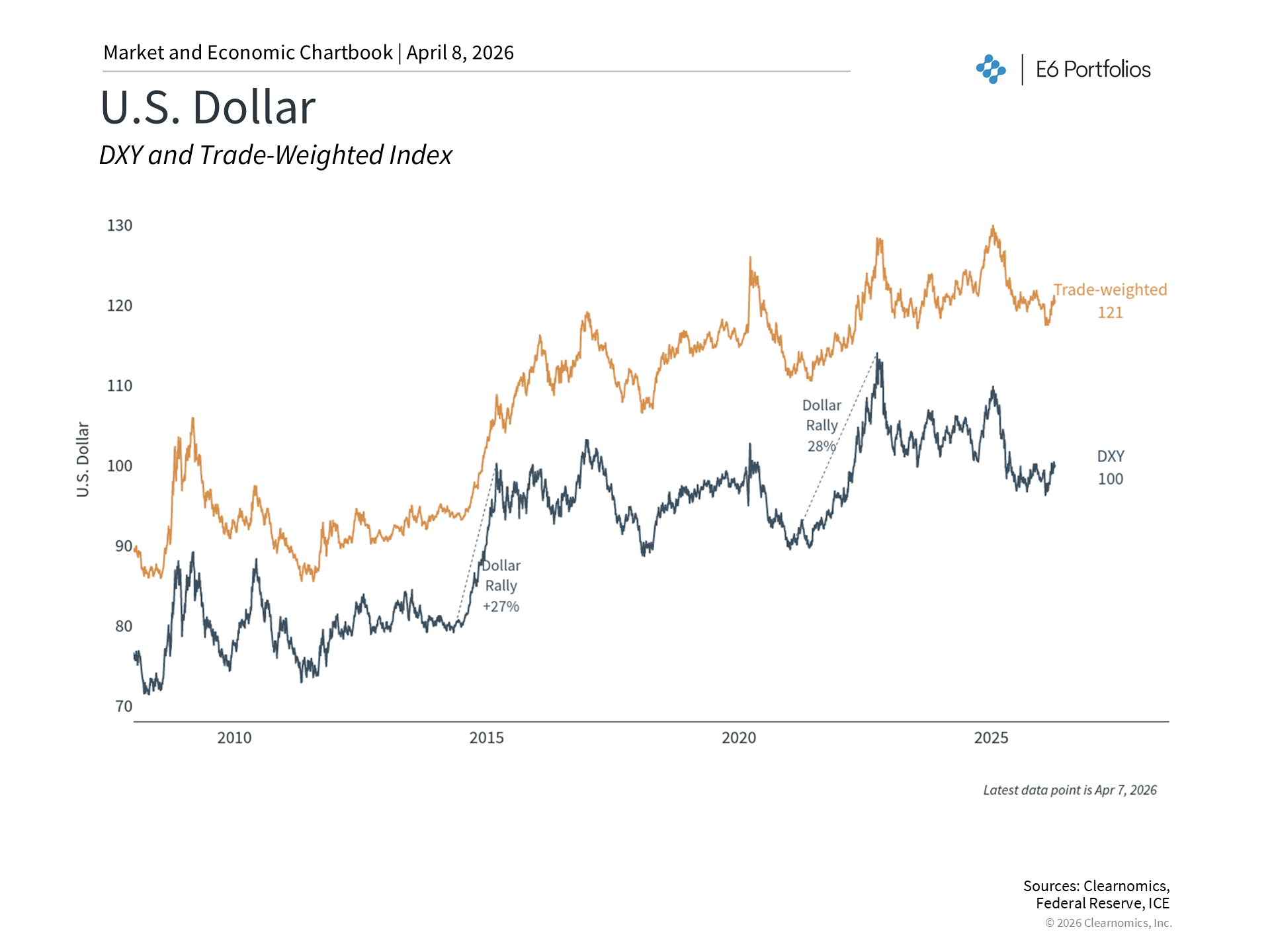 |
The dollar hit a peak around 114 on the dollar index (DXY) in 2022, then gradually weakened as global growth stabilized. Last year, tariffs pushed it below 100 for the first time in three years. More recently, the dollar has bounced back as investors have sought safety during times of global uncertainty. Even so, the dollar remains stronger than it has been through much of its history.
First, a stronger dollar is not always a good thing. While a strong dollar makes imported goods and foreign travel cheaper for consumers, it can hurt U.S. businesses that sell products abroad, since their goods become more expensive for foreign buyers. Many countries have historically tried to keep their currencies weaker to make their exports more competitive. The ideal currency level balances the needs of consumers, businesses, and the broader economy.
Second, the dollar’s value is shaped by many factors, including interest rates, trade policy, and government spending. Interestingly, last year’s tariffs actually weakened the dollar rather than strengthening it, which is the opposite of what economic theory would predict. This may be partly due to concerns that ongoing budget deficits could slowly erode the dollar’s strength over time — a concept sometimes called the “debasement trade.”
Third, the dollar’s recent rebound is a reminder of its role as a “safe haven” — meaning investors tend to move money into dollars and U.S. government bonds during uncertain times. The dollar still makes up the largest share of global currency reserves and is used in a huge portion of international transactions. While questions about the dollar’s long-term dominance are not new, investors have consistently returned to it during difficult periods.
A weaker dollar has helped international stock returns
 |
When the dollar weakens, it tends to boost returns on international investments for U.S.-based investors. This is because foreign assets are priced in local currencies, and when those currencies are worth more relative to the dollar, the investment translates into more dollars when converted back. In 2025, this effect helped international stocks significantly outperform U.S. stocks, with developed markets (MSCI EAFE) returning 31.9% and emerging markets (MSCI EM) returning 34.4%, both well ahead of the S&P 500.
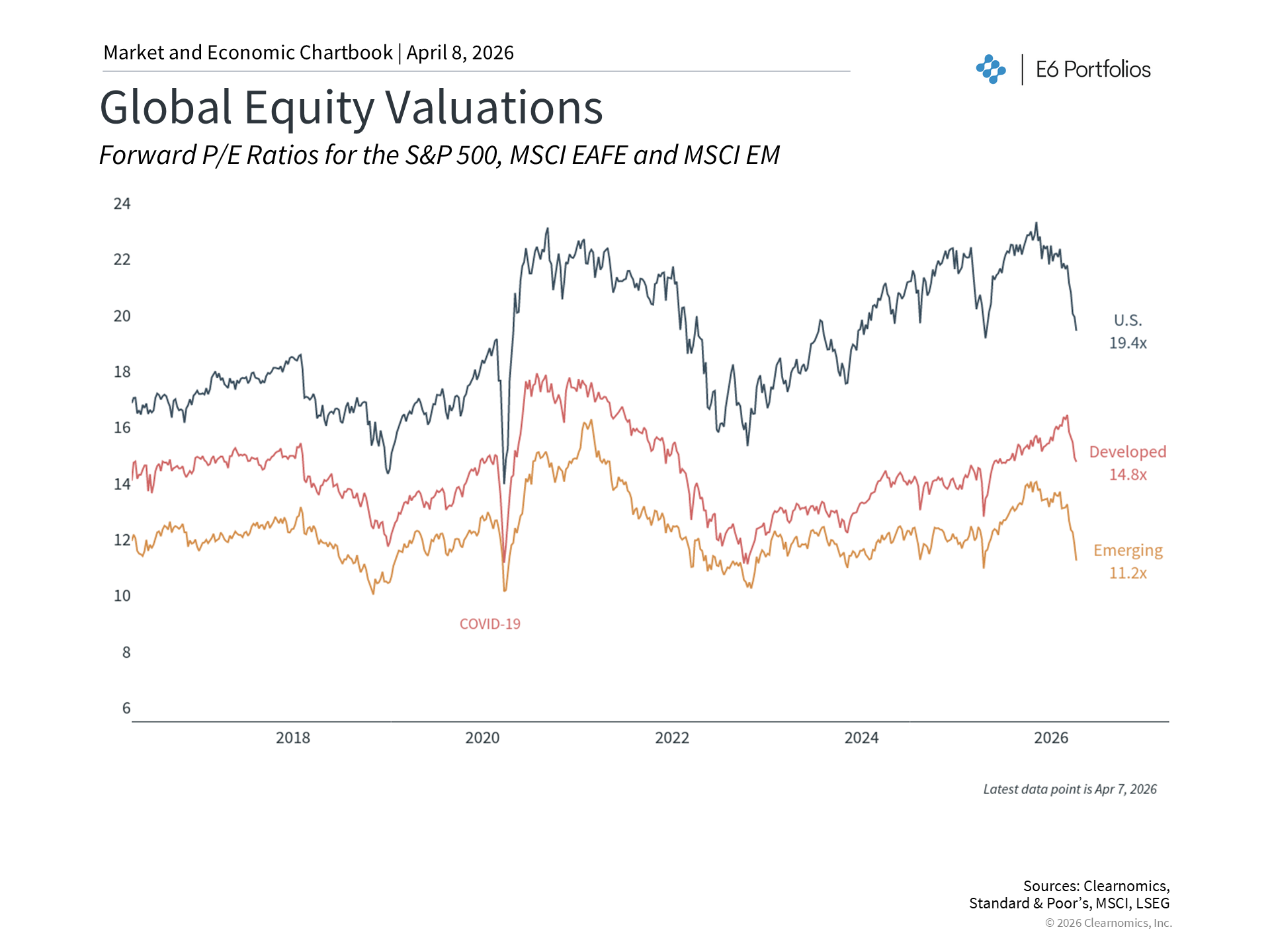
International stocks also tend to be less expensive than U.S. stocks based on valuation measures like the price-to-earnings ratio (P/E) — which compares a stock’s price to its earnings and is a common way to assess whether stocks are cheap or expensive. Developed markets currently trade at a P/E of 14.9x and emerging markets at 11.8x, compared to 19.9x for the S&P 500. While lower valuations don’t predict short-term performance, they are a useful input when building a balanced portfolio.
So far in 2026, international markets have continued to modestly outperform the S&P 500, even as the dollar has partially recovered. This is a meaningful shift after years of U.S. stocks leading global markets, and it reinforces the value of maintaining international exposure in a diversified portfolio.
Gold has pulled back after reaching record highs
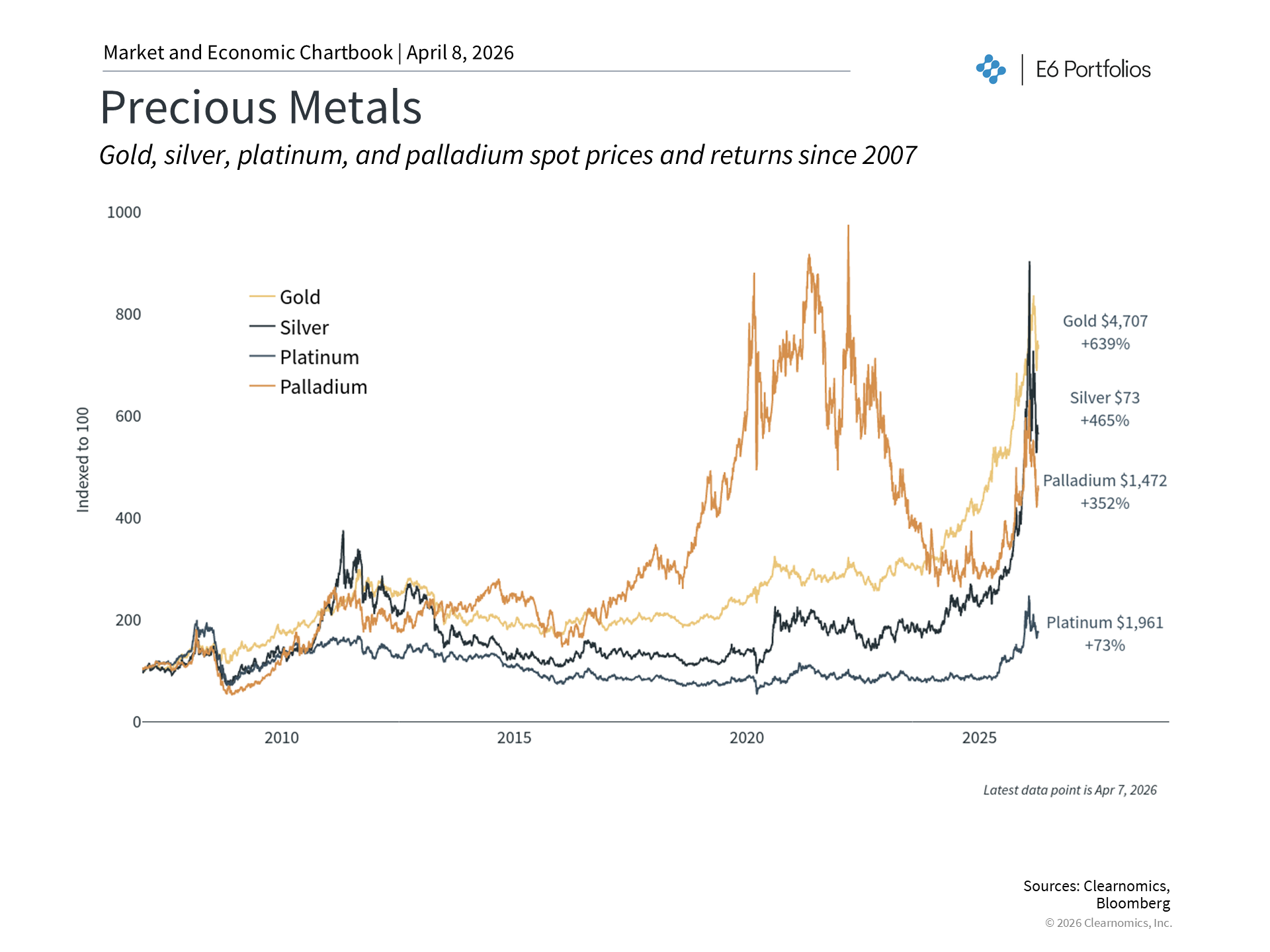 |
Gold has been one of the most talked-about assets in recent years. Rising government deficits, lower interest rates, geopolitical tensions, and concerns about currency debasement all created a favorable backdrop for gold, pushing prices to an all-time high of $5,417 per ounce in late January. Since then, gold has declined roughly 14% from that peak, even as many of those factors remain in place.
Part of the reason for the pullback is that gold had already attracted a lot of investor interest during its rally. When many investors own an asset expecting it to keep rising, it can start moving more like other risky assets — meaning it may be sold during market stress rather than acting as a true safe haven. The recent strength of the dollar has also weighed on gold prices.
This is not the first time gold has behaved unexpectedly. Between 2011 and 2020, gold was essentially flat despite low interest rates and several periods of market turbulence. Rather than viewing gold on its own, it’s more useful to see it as one piece of a diversified portfolio. Its value lies in the fact that it often behaves differently from stocks and bonds, which can help smooth out portfolio returns over time.
The bottom line? The dollar, international stocks, and assets such as gold can all serve different roles in balanced portfolios. During periods of uncertainty, it’s important to maintain a broader perspective on the driving factors behind these assets. Ultimately, a well-constructed portfolio remains the most reliable way to achieve long-term financial goals.